
P-Type solar panels price in Pakistan: The Best Budget Choice for 2026
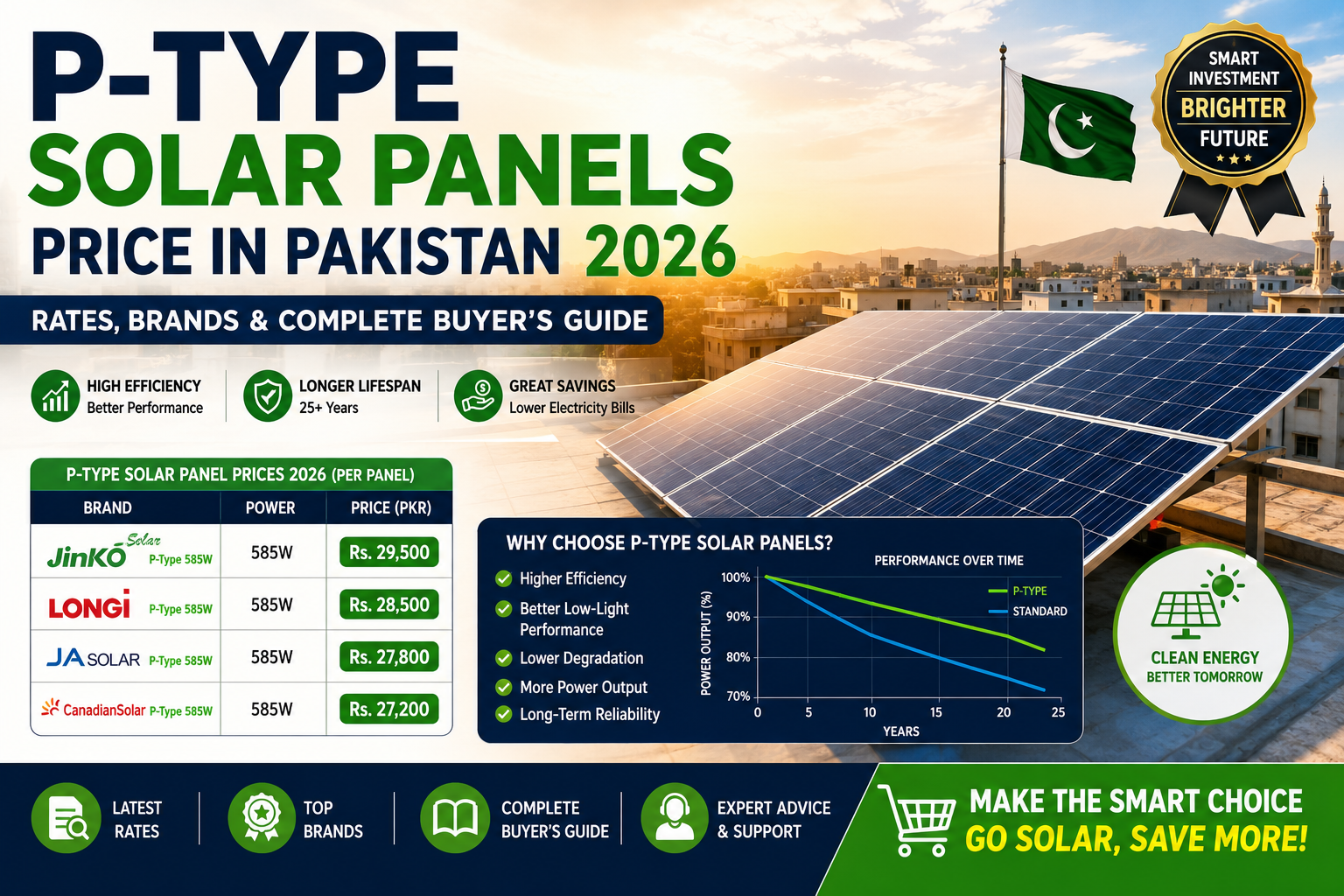
If you are planning to install a solar system in Pakistan and working with a tight budget, P-Type solar panels are one of the most widely available and affordable options in today’s market. In this guide, you will find everything you need to know about P-Type solar panels price in Pakistan in 2026 — including per-watt rates from major brands, a full explanation of how P-Type technology works, its advantages and disadvantages, and honest advice on whether a P-Type panel is right for your home or business.
Quick Rate Update (May 2026):P-Type Solar Panels Price in Pakistan currently range from Rs. 28 to Rs. 34 per watt for A-grade Tier-1 documented panels, depending on brand, wattage, and order size. Prices are ex-Lahore and subject to daily market changes.
What Is a P-Type Solar Panels?
A P-Type solar panels uses a silicon wafer that has been doped with boron, creating a positively charged (P-type) semiconductor layer. This is the older and more established of the two main solar cell technologies — the other being N-Type. P-Type panels dominated the global solar market for decades and are still widely available in Pakistan in 2026.
The most common P-Type technology available in Pakistan today is PERC (Passivated Emitter and Rear Cell) — an upgraded version of the classic P-Type design that adds a passivation layer on the rear of the cell to reflect unused light back into the cell and boost efficiency. P-Type PERC panels are what most Pakistani dealers refer to when they sell standard “monocrystalline” or “A-Grade” panels at the Rs. 28–34 per watt price range.
P-Type Solar Panels Price in Pakistan 2026 — Brand-Wise Rates
The table below shows current market rates for P-Type Solar Panels Price in Pakistan as of May 2026. These are Lahore wholesale (ex-Lahore) pallet rates for A-Grade documented Tier-1 panels. Loose panel prices may be 25 paisa per watt higher. Always confirm with your dealer before purchase.
| Brand | Price Per Watt (Rs.) | Wattage | Price Per Watt (Rs.) | Total Price (Rs.) | Status |
|---|---|---|---|---|---|
| Jinko Solar | P-Type Bifacial A-Grade | 540W | Call for Rate | - | In stock |
| JA Solar | P-Type Mono PERC | 550W | Rs. 28–30 | ~Rs. 15,400–16,500 | Limited Stock |
| JA Solar | P-Type Mono PERC | 565W | Rs. 37 | ~Rs. 20,905 | Limited Stock |
| Trina Solar | P-Type A-Grade | 610W | Rs. 38 | ~Rs. 23,180 | In stock |
| ZN Shine | P-Type Bifacial A-Grade | 585W | Rs. 38 | ~Rs. 22,230 | In Stock |
| Osda Energy | P-Type A-Grade Tier-1 | 585W | Rs. 37 | ~Rs. 21,645 | In Stock |
| RENA Solar | P-Type Bifacial A-Grade | 585W | Rs. 38 | ~Rs. 22,230 | Limited Stock |
Important Note:P-Type Solar Panels (especially older PERC models) are becoming less available in Pakistan's market as the industry shifts toward N-Type TOPCon technology. If you are planning a system today, confirm stock availability with your dealer before finalising your order.
Advantages of P-Type Solar Panels in Pakistan
1. Lower Upfront Cost
P-Type panels are generally 5–10% cheaper per watt compared to N-Type panels. For buyers on a fixed budget — such as farmers installing irrigation systems or households with limited savings — this price difference can significantly reduce the total system cost. A 5kW P-Type system can cost Rs. 30,000–50,000 less than an equivalent N-Type setup.
2. Mature Technology with Wide Availability
P-Type PERC technology has been manufactured at scale for over 15 years. This means there are more suppliers, more spare parts, and more technicians familiar with this technology across Pakistan. In smaller cities and rural areas, P-Type panels are often the most easily sourced option.
3. Adequate Performance for Off-Grid and Agricultural Use
For off-grid solar systems — such as agricultural tube wells, poultry farms, and remote homes not connected to net metering — P-Type panels still deliver solid and reliable performance. If you are not selling electricity back to the grid and your priority is simply to power equipment during daylight hours, P-Type panels are a perfectly practical choice.
4. Good Performance in Moderate Climates
In Pakistan’s cooler northern regions — including Murree, Abbottabad, Swat, and Gilgit — where summer temperatures are lower, the heat-related efficiency gap between P-Type and N-Type panels is much smaller. P-Type panels are a well-suited option for these areas.
Disadvantages of P-Type Solar Panels in Pakistan
1. Higher Degradation Rate in Pakistan’s Heat
This is the most important disadvantage to understand for Pakistani buyers. P-Type panels have a temperature coefficient of around -0.38% per °C. Pakistan’s summer roof temperatures routinely reach 65°C — meaning at that temperature, a P-Type panel loses approximately 15.2% of its rated output due to heat alone. An N-Type panel in the same conditions loses only about 11.2% — a 4% real-world advantage, every hot day, for 25 years.
2. Light-Induced Degradation (LID)
P-Type panels are susceptible to a known defect called Light-Induced Degradation (LID). Because boron — used in P-Type doping — interacts with oxygen in the silicon, a P-Type panel can lose up to 2–3% of its output in the first few weeks of sunlight exposure. N-Type panels are completely immune to LID, giving them a lasting efficiency advantage from day one.
3. Higher Annual Degradation Rate
P-Type PERC panels typically degrade at 0.45–0.55% per year, compared to 0.30–0.40% for N-Type panels. Over a 25-year lifespan, this compounds into a meaningful difference in total electricity generated. A P-Type panel may produce 3–5% less total energy over its lifetime compared to a same-wattage N-Type panel.
4. Declining Market Availability
The global solar industry is rapidly transitioning to N-Type TOPCon technology. In Pakistan’s wholesale market, top Tier-1 brands like Jinko, Longi, Canadian Solar, and JA Solar are all prioritising N-Type production. P-Type models are increasingly out of stock or only available in limited quantities — which can create warranty and replacement challenges in the future.
P-Type vs N-Type Solar Panels — Quick Comparison for Pakistan Buyers
| Feature | P-Type (PERC) | N-Type (TOPCon) |
|---|---|---|
| Efficiency | 20.1% – 21.2% | 21.5% – 22.5% |
| Annual Degradation | 0.45% – 0.55% | 0.30% – 0.40% |
| Temperature Coefficient | -0.38%/°C | -0.28%/°C |
| LID Susceptibility | Yes — up to 2–3% loss | No — immune to LID |
| Price per Watt (2026) | Rs. 28–38 (lower) | Rs. 39–45 (higher) |
| Heat Performance (45°C+ | Moderate | Excellent |
| Market Availability | Declining | Growing |
| Best For | Budget systems, farms, off-grid | Homes, net metering, commercial |
Who Should Buy P-Type Solar Panels in Pakistan?
Despite the disadvantages listed above, P-Type panels are still a valid choice for a specific category of Pakistani buyers:
Farmers and agricultural users who need a simple, low-cost off-grid system to power tube wells or irrigation during daylight hours will find P-Type panels practical and affordable. The lower upfront cost outweighs the efficiency gap when the system is not connected to net metering.
Buyers in cooler regions of Pakistan (KPK, northern Punjab, AJK) where summer temperatures are lower will see less heat-related performance difference between P-Type and N-Type panels, making P-Type a reasonable value choice.
Short-term or temporary installations — such as construction sites, events, or seasonal setups — where long-term degradation does not matter, P-Type panels offer the lowest cost per installed watt.
Our Recommendation If you are installing a permanent home solar system in Lahore, Karachi, Multan, or any other hot-climate city in Pakistan — and you plan to use net metering — we recommend spending the extra 5–10% per watt on N-Type panels. The long-term electricity savings more than cover the difference. For agricultural and off-grid use, P-Type PERC panels remain an excellent budget option.
Factors Affecting P-Type Solar Panels Price in Pakistan
USD/PKR Exchange Rate: All solar panels are imported from China and priced in US Dollars. Any movement in the dollar rate directly affects the per-watt PKR price. A 5-rupee increase in the dollar rate can raise panel prices by Rs. 1–2 per watt.
Import Duties and GST: The Pakistani government imposes regulatory duties and 17% GST on imported solar panels. Policy changes can create sudden price shifts of 10–15%. In 2025–26, some duty exemptions were applied to promote renewable energy adoption, keeping prices more stable.
Pallet vs Loose Purchase: Buying a full pallet (30–36 panels) saves approximately 25 paisa per watt compared to buying individual loose panels. For large systems, always ask for the pallet rate.
City Pricing: Lahore’s wholesale market (Gulberg, Ferozpur Road) typically offers the most competitive rates. Buyers in Islamabad, Peshawar, or Quetta may pay Rs. 1–3 per watt more due to transport costs. For up-to-date daily rates, check our Solar Price Today page, updated every morning before 9 AM.
For a full comparison of all solar panel types available in Pakistan, including N-Type and Bi-Facial panels, visit our Solar Panels category page or compare complete system costs on our Packages page.
Frequently Asked Questions — P-Type Solar Panels in Pakistan
P-Type solar panels in Pakistan are currently priced between Rs. 28 and Rs. 38 per watt for A-Grade Tier-1 documented panels, depending on the brand, wattage, and whether you are buying at pallet or loose rate. Prices are ex-Lahore and updated daily on our Solar Price Today page.
Yes, P-Type solar panels are still reliable for off-grid, agricultural, and budget-focused installations. However, for net metering systems or homes in hot cities like Lahore and Multan, N-Type panels are now recommended due to better heat resistance and lower long-term degradation.
P-Type panels use boron-doped silicon and are more affordable but degrade faster and perform less efficiently in high temperatures. N-Type panels use phosphorus-doped silicon, are more resistant to heat and light-induced degradation, and maintain higher efficiency over 25 years — but cost 5–10% more per watt.
Among P-Type options still available in Pakistan, Trina Solar, JA Solar, and Osda Energy offer good quality A-Grade Tier-1 panels with documented warranties. Always verify serial numbers and buy from an authorized dealer to ensure authenticity.
Yes, NEPRA-approved P-Type solar panels from Tier-1 brands are eligible for net metering in Pakistan. However, due to their higher degradation rate and lower heat performance, you will generate less electricity over 25 years compared to an N-Type system of the same wattage — reducing your total savings.
You need approximately 10 panels of 550W to build a 5kW solar system (10 × 550W = 5,500W ≈ 5kW). A certified solar installer can confirm the exact number based on your roof layout and electricity consumption.
Important: Always ask your supplier for the original P-Type Solar Panel warranty card and serial number before purchase. Undocumented panels do not qualify for manufacturer warranty claims.
Buy P-Type Solar Panels in Pakistan – Get a Free Quote
Want to know how to buy P-Type solar panels in Pakistan from a trusted source? Our team in Gulberg, Lahore sources directly from verified importers and updates all prices daily. Call or WhatsApp us at 03096700180 for a free quote, system sizing advice, and installation guidance anywhere in Pakistan. Also compare: N-Type Solar Panel Price in Pakistan | Bi-Facial Solar Panel Price in Pakistan | Solar Price Today | 5kW Solar System Package | 10kW Solar System Package