
P-Type Solar Panel Lifespan in Pakistan 2026 – Hidden Degradation Facts Revealed
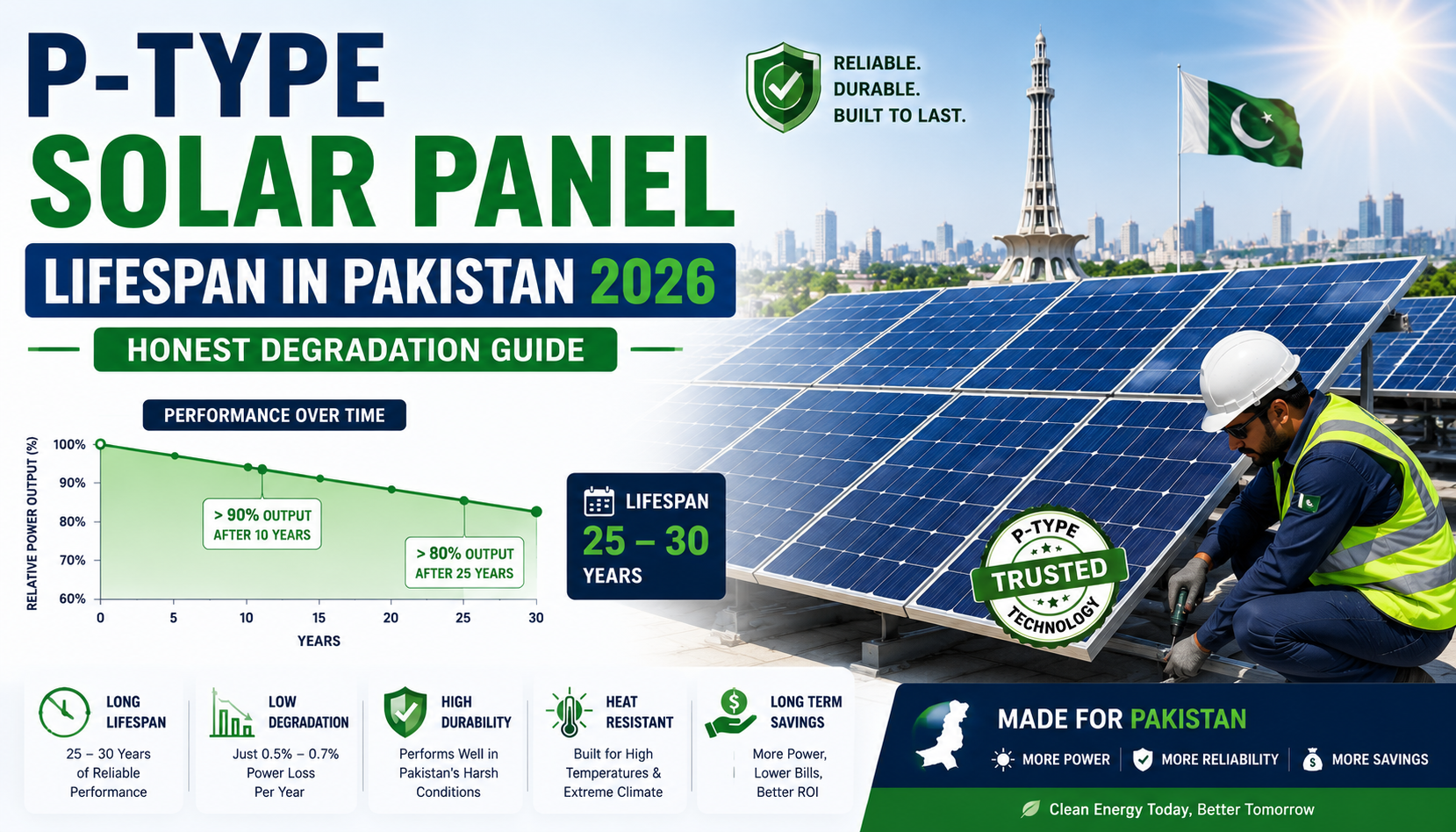
Understanding P-Type solar panel lifespan in Pakistan is essential before you invest in a solar system. Many buyers focus only on price and ignore how long their panels will actually perform at full capacity. P-Type solar panel lifespan in Pakistan is directly affected by Pakistan’s extreme heat, heavy dust, and high UV exposure — making it one of the most important topics any Pakistani solar buyer must understand in 2026.
This guide gives you a complete, honest breakdown of P-Type solar panel lifespan in Pakistan. You will learn about degradation rates, Light-Induced Degradation, warranty explained in simple terms, how Pakistan’s climate affects your panels, and the proven steps to maximize P-Type solar panel lifespan in Pakistan for a full 25 years.
Quick Rate Update (May 2026):Most Tier-1 solar panels have a degradation rate of 0.5% to 1% per year. A 25-year performance warranty guarantees panels still produce at least 85 to 90% of their original power in year 25. For P-Type PERC panels specifically, the rate sits at the higher end of this range. Check our Solar Price Today page for daily updated P-Type panel rates in Pakistan.
What Is P-Type Solar Panel Lifespan in Pakistan?
P-Type solar panel lifespan in Pakistan refers to how many years a P-Type PERC panel continues to generate electricity at an acceptable level of performance. Most manufacturers advertise a 25-year lifespan for P-Type panels. However the actual usable lifespan depends heavily on panel quality, installation quality, and maintenance.
Research conducted on field-aged PV modules in Pakistan — some as old as 30 to 35 years — found that older panels showed significant degradation after working for a good number of years in the field. A drop of 28.68% in output power was observed in 30-year-old modules, while 10-year-old modules showed a drop of 22.21% in maximum output power. This research is published on PubMed Central — National Institutes of Health.
This confirms that Pakistan’s harsh climate — high heat, dust, and UV — accelerates panel aging. Understanding P-Type solar panel lifespan in Pakistan therefore means understanding how Pakistani conditions specifically affect your panels.
P-Type Solar Panel Lifespan in Pakistan — The Numbers Explained
Here is a clear breakdown of what P-Type solar panel lifespan in Pakistan looks like in real numbers over 25 years:
| Year | Expected Output (550W Panel) | Remaining Capacity |
|---|---|---|
| Year 1 | 550W | 100% |
| Year 5 | ~537W | ~97.7% |
| Year 10 | ~524W | ~95.3% |
| Year 15 | ~511W | ~92.9% |
| Year 20 | ~498W | ~90.5% |
| Year 25 | ~485W | ~88.2% |
These figures assume a 0.45% annual degradation rate — the lower end for P-Type PERC panels. P-Type PERC modules lose 0.45 to 0.55% per year while N-Type panels lose only about 0.30% per year according to JA Solar’s official technical documentation. This means N-Type panels retain more output over their lifespan — but P-Type panels still deliver strong value for budget-focused buyers.
For a full comparison of P-Type and N-Type panels, visit our Solar Panels category page.
The Biggest Threat to P-Type Solar Panel Lifespan in Pakistan — LID
The single biggest threat to P-Type solar panel lifespan in Pakistan is Light-Induced Degradation — commonly known as LID. This is a unique defect that affects P-Type panels and does not affect N-Type panels at all.
What Is LID?
LID occurs when boron — used in P-Type silicon doping — reacts with oxygen present in the silicon wafer during the first few weeks of sunlight exposure. This reaction creates boron-oxygen complexes inside the cell that permanently reduce the panel’s ability to convert sunlight into electricity. According to Trina Solar’s official technology page, this is one of the key reasons the industry is transitioning from P-Type to N-Type TOPCon technology globally.
How Much Output Does LID Cause a P-Type Panel to Lose?
A P-Type panel typically loses 1 to 3% of its rated output due to LID alone — in the very first weeks of operation. This loss is permanent and cannot be recovered. It happens before you have even received your first electricity bill savings from your new solar system.
Does LID Affect P-Type Solar Panel Lifespan in Pakistan More Than Other Countries?
Yes. Pakistan’s extremely high solar irradiance — averaging 5.3 kWh per square meter per day according to Global Solar Atlas — means Pakistani panels are exposed to more intense sunlight than panels in Europe or North America. This accelerates the LID process and means Pakistani P-Type panels reach their full LID loss faster than panels in cooler, lower-irradiance climates.
How Pakistan's Climate Affects P-Type Solar Panel Lifespan
Pakistan’s climate is one of the most demanding environments for solar panels in the world. Here is how each climate factor specifically impacts P-Type solar panel lifespan in Pakistan:
Extreme Heat — The Biggest Factor
Pakistan’s rooftop temperatures regularly reach 65°C in summer. P-Type panels have a temperature coefficient of -0.38% per °C. At 65°C that means approximately 15% output loss on every hot summer day — for 25 years. According to Jinko Solar’s official N-Type vs P-Type comparison, N-Type panels perform significantly better in high-temperature environments like Pakistan’s climate.
Heavy Dust and Smog
Pakistan’s cities — especially Lahore, Faisalabad, and Multan — experience some of the worst air quality in Asia during October to February. Dust and smog accumulation on panel glass reduces output by 15 to 25% if panels are not cleaned regularly. This does not permanently reduce P-Type solar panel lifespan in Pakistan but dramatically reduces annual energy production if ignored.
UV Exposure and EVA Browning
Pakistan’s high UV radiation accelerates the yellowing and browning of the EVA encapsulant layer inside solar panels. Research published on PubMed Central on 30-year-old PV modules in Pakistan found that a greater drop in output was attributed to severe browning of EVA inside the panels. This is a long-term aging process that cannot be prevented but can be slowed by buying panels with high-quality encapsulant materials from verified Tier-1 manufacturers.
Monsoon and Humidity
Pakistan’s monsoon season (July to September) brings high humidity particularly in Karachi, Lahore, and coastal areas. Humidity accelerates corrosion of cell contacts and frame joints. Always ensure your panels have an IP68-rated junction box and fully sealed aluminum frames to protect against moisture ingress.
P-Type Solar Panel Lifespan in Pakistan — Warranty Explained
Understanding the warranty is essential to understanding the true P-Type solar panel lifespan in Pakistan. A genuine A-Grade Tier-1 P-Type panel comes with two separate warranties:
1. Product Warranty (12 Years)
The product warranty covers manufacturing defects — cracked glass, delamination, junction box failure, frame damage, and cell failures caused by production errors. If any of these defects appear within 12 years the manufacturer replaces the panel free of charge.
This warranty is only valid if you buy from an authorized dealer with original documentation. Grey-market panels sold in Pakistan often carry no enforceable manufacturer product warranty. According to Trina Solar’s official warranty terms, warranty claims must be supported by original purchase documentation and serial number verification.
2. Linear Performance Warranty (25 Years)
The performance warranty guarantees that your P-Type panel will produce a minimum percentage of its rated output at each year of its life. Here is what a standard P-Type performance warranty looks like:
| Year | Minimum Guaranteed Output |
|---|---|
| Year 1 | 97.5% (accounts for LID) |
| Year 2–25 | Degrades no more than 0.55% per year |
| Year 25 | Minimum 80% of rated output |
This means a 550W P-Type panel must still produce at least 440W after 25 years — guaranteed in writing by the manufacturer. According to IRENA, a robust performance warranty from a bankable Tier-1 manufacturer is one of the most important factors in assessing the true long-term value of any solar panel.
What Voids Your P-Type Panel Warranty in Pakistan?
Several common situations void the manufacturer warranty. Buying from an unauthorized dealer voids the warranty immediately. Improper installation by an uncertified installer also voids the warranty in most cases. Physical damage caused by improper cleaning or maintenance voids coverage. Always keep your original warranty card, purchase receipt, and installation records safely stored for the full 25-year period.
P-Type vs N-Type — Lifespan Comparison for Pakistan Buyers
| Feature | P-Type (PERC) | N-Type (TOPCon) |
|---|---|---|
| Advertised Lifespan | 25 years | 25–30 years |
| Annual Degradation | 0.45% – 0.55% | 0.30% – 0.40% |
| Output at Year 25 | ~80% minimum guaranteed | ~87% minimum guaranteed |
| LID Susceptibility | Yes — 1 to 3% initial loss | No — immune to LID |
| Price per Watt (2026) | Rs. 28–38 (lower) | Rs. 39–45 (higher) |
| Heat Performance (65°C) | Loses ~15.2% output | Loses ~11.2% output |
| EVA Browning Risk | Higher | Lower |
| Best For | Budget systems, farms, off-grid | Homes, net metering, commercial |
According to Jinko Solar’s official product specifications, N-Type TOPCon panels carry a minimum 87.4% output guarantee after 30 years — significantly better than the 80% guaranteed by P-Type panels after 25 years. For P-Type panel brand-wise prices in Pakistan read our detailed P-Type Solar Panel Price in Pakistan guide.
7 Proven Ways to Maximize P-Type Solar Panel Lifespan in Pakistan
Maximizing P-Type solar panel lifespan in Pakistan requires consistent action across installation, cleaning, monitoring, and maintenance. Here are 7 proven steps:
1. Buy Only A-Grade Tier-1 Documented Panels
B-grade solar panels typically last only 3 to 5 years in Pakistan’s harsh climate before output drops to unacceptable levels. Always buy A-Grade Tier-1 documented panels with original flash reports and manufacturer warranty cards from brands like JA Solar, Trina Solar, or Jinko Solar. This single decision has the greatest impact on P-Type solar panel lifespan in Pakistan.
2. Install at the Correct Tilt Angle
Install your panels facing true south at 25 to 30 degrees tilt. Correct orientation reduces hotspot formation and ensures uniform heat distribution across the panel surface. This reduces accelerated aging caused by uneven thermal stress.
3. Clean Panels Every 2 to 4 Weeks
Clean your panels regularly using a soft cloth or gentle water rinse early in the morning. Dust accumulation increases the surface temperature of panels which directly accelerates degradation. In Lahore, Faisalabad, and Multan weekly cleaning during smog season is recommended.
4. Ensure Proper Ventilation Under Panels
A gap of at least 10 to 15 cm between the panel and the roof surface is essential for airflow and cooling. Panels with no ventilation gap run significantly hotter. This directly shortens P-Type solar panel lifespan in Pakistan by accelerating cell degradation and EVA browning.
5. Use Quality Mounting Hardware
Use anodized aluminum or hot-dip galvanized steel mounting rails. Cheap painted steel rails rust within 2 to 3 years in Pakistan’s climate. Corroded mounting hardware creates vibration and stress on panel frames leading to micro-cracks and early cell failure.
6. Have an Annual Professional Inspection
Have a certified technician inspect your system once every year. Check all MC4 connectors for corrosion, inspect every panel for micro-cracks and delamination, check cable insulation for UV damage, and review inverter performance logs for any error codes indicating underperforming panels.
7. Monitor Output Monthly
Track your system’s monthly production in a simple log. A decline faster than 0.55% per year in your P-Type system warrants an immediate professional inspection. According to NEPRA’s net metering guidelines, all net-metered systems must maintain performance records — making monthly monitoring both a smart maintenance habit and a regulatory requirement.
Real Cost of P-Type Solar Panel Lifespan Degradation Over 25 Years
Here is a realistic calculation showing the financial impact of P-Type degradation over 25 years for a 5kW system in Pakistan:
| Year | Annual Output (units) | Annual Savings (Rs. at Rs.60/unit) | Cumulative Savings |
|---|---|---|---|
| Year 1 | 6,500 | Rs. 390,000 | Rs. 390,000 |
| Year 5 | 6,357 | Rs. 381,420 | Rs. 1,923,000 |
| Year 10 | 6,175 | Rs. 370,500 | Rs. 3,779,000 |
| Year 15 | 5,993 | Rs. 359,580 | Rs. 5,569,000 |
| Year 20 | 5,811 | Rs. 348,660 | Rs. 7,290,000 |
| Year 25 | 5,629 | Rs. 337,740 | Rs. 8,943,000 |
Over 25 years a well-maintained 5kW P-Type system saves approximately Rs. 89 to 95 lakh in electricity bills — even accounting for annual degradation. For complete system package pricing visit our 5kW System, 3kW System, and 10kW+ System pages.
Frequently Asked Questions — P-Type Solar Panel Lifespan in Pakistan
The standard advertised P-Type solar panel lifespan in Pakistan is 25 years. A genuine A-Grade Tier-1 P-Type panel comes with a 25-year linear performance warranty guaranteeing at least 80% of rated output in year 25. Actual lifespan in Pakistan's harsh climate depends on panel quality, installation, and maintenance.
P-Type PERC panels degrade at 0.45 to 0.55% per year. This is higher than N-Type TOPCon panels which degrade at only 0.30 to 0.40% per year. Over 25 years this difference compounds significantly — making N-Type a better long-term investment for net-metered home systems.
Yes. Pakistan's rooftop temperatures regularly reach 65°C in summer. At this temperature a P-Type panel loses approximately 15.2% of its rated output due to heat. This does not permanently reduce lifespan but significantly reduces annual energy production — compounding over 25 years into a large loss in total savings.
LID stands for Light-Induced Degradation. It is a permanent 1 to 3% output loss that occurs in P-Type panels during the first few weeks of sunlight exposure. It is caused by a boron-oxygen reaction inside the silicon cell. N-Type panels are completely immune to LID. Pakistan's high solar irradiance makes LID happen faster than in lower-irradiance countries.
Buy only A-Grade Tier-1 documented panels, install at the correct south-facing tilt angle, clean panels every 2 to 4 weeks, ensure a 10 to 15 cm ventilation gap under the panels, use quality aluminum mounting hardware, have an annual professional inspection, and monitor monthly output to detect early degradation.
No. B-grade panels typically last only 3 to 5 years in Pakistan's harsh climate before output drops to unacceptable levels. Always buy A-Grade Tier-1 documented panels with original manufacturer warranty cards from trusted brands like JA Solar, Trina Solar, or Jinko Solar. The small price saving on B-grade panels is completely wiped out by early replacement costs.
Important: Always ask your supplier for the original P-Type Solar Panel warranty card and serial number before purchase. Undocumented panels do not qualify for manufacturer warranty claims.
Buy Long-Lasting P-Type Solar Panels in Pakistan – Get a Free Quote
Looking for genuine A-Grade P-Type solar panels with full 25-year warranty in Pakistan? Our team in Gulberg, Lahore sources directly from verified importers and updates all prices daily. Call or WhatsApp us at 03096700180 for a free quote, lifespan advice, and installation guidance anywhere in Pakistan.
Also compare: JA Solar Official | Trina Solar Official | Jinko Solar Official | Solar Price Today | 5kW Solar System Package