
How to Buy P-Type Solar Panels in Pakistan 2026 – Best Complete Guide
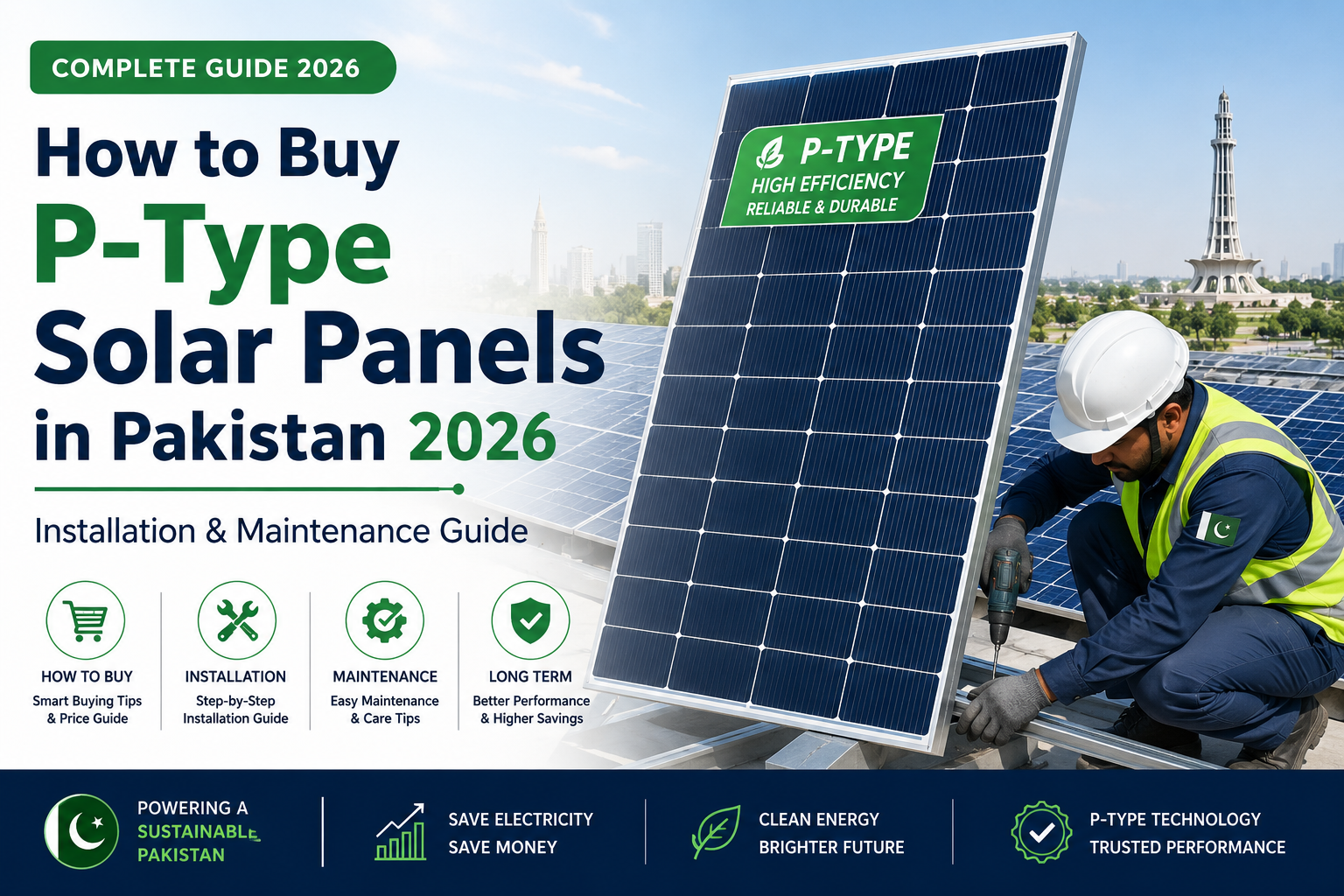
Knowing how to buy P-Type solar panels in Pakistan correctly is the most important step before spending your money. How to buy P-Type solar panels is a question thousands of Pakistani homeowners, farmers, and business owners are asking in 2026. This guide gives you the complete answer in simple steps.
According to Wikipedia, Pakistan imported more solar panels than any other country in the world in 2024. With this explosion in demand came a flood of grey-market and B-grade panels. Buying the wrong panel can cost you lakhs of rupees in losses over 25 years.
This step-by-step guide covers exactly how to buy P-Type solar panels the right way. You will learn how to calculate your energy needs, choose the right dealer, verify panel authenticity, install correctly, and maintain your panels for maximum output.
Quick Tip (May 2026):Always buy P-Type panels from an authorized Tier-1 dealer. Ask for the original documented warranty card before paying. Check our Solar Price Today page for the latest daily per-watt rates before visiting any dealer.
Why Knowing How to Buy P-Type Solar Panels Matters in 2026
How to buy P-Type solar panels is not just about price. It is about getting genuine, documented, A-Grade panels that will perform for 25 years.
Pakistan’s solar market has grown at an extraordinary pace. According to IRENA, solar is now the fastest growing energy source globally. As of 2025, solar accounts for more than 25% of Pakistan’s total electricity production.
This rapid growth has attracted both genuine dealers and unscrupulous sellers. Buyers who do not know how to buy P-Type solar panels correctly often end up with panels that lose 30 to 40% of their output within just 5 years.
Step 1 — Calculate Your Energy Needs Before You Buy P-Type Solar Panels
The most costly mistake Pakistani buyers make is not calculating their electricity consumption first. Before you buy P-Type solar panels, always complete this step.
Check Your Last 12 Electricity Bills
Look at your WAPDA bill for the past 12 months. Note your monthly unit consumption in kWh. Take the 12-month average — this is your true baseline.
According to NEPRA, the average Pakistani household consumes between 250 and 600 units per month. Many buyers only check their summer bill and end up with the wrong system size.
List All Your Appliances
Write down every appliance — fans, lights, air conditioners, refrigerator, washing machine, water pump, and television. Note how many hours each runs per day. This gives your installer the data needed to size your system correctly.
Choose the Right System Size
Here is a quick reference guide based on common Pakistani household sizes:
| System Size | Suitable For | Panels Needed (550W P-Type) | Estimated Monthly Output |
|---|---|---|---|
| 3kW System | Small homes, 2–3 rooms | 6 panels | ~360–420 units/month |
| 5kW System | Medium homes, 4–5 rooms | 10 panels | ~600–700 units/month |
| 8kW System | Large homes, small offices | 15 panels | ~960–1,100 units/month |
| 10kW System | Large offices, factories | 19 panels | ~1,200–1,400 units/month |
For complete system costs including inverter and installation charges, visit our 3kW System, 5kW System, and 10kW+ System packages pages.
Step 2 — Choose the Right System Type When You Buy P-Type Solar Panels
When you buy P-Type solar panels you also need to decide which type of solar system suits your situation. This affects your total cost and monthly savings directly.
On-Grid System — Best for Urban Areas
An on-grid system connects your P-Type panels directly to WAPDA through a solar inverter. It does not require batteries. Excess electricity is exported to the grid through net metering.
According to NEPRA, Pakistan had over 2,813 MW of net-metered rooftop solar installed as of March 2025. The payback period for a well-sized on-grid P-Type system is typically 3 to 4 years.
Hybrid System — Best for Load Shedding Areas
A hybrid system uses P-Type panels, a hybrid inverter, and batteries. During the day the panels power your home and charge the batteries. During load shedding the batteries provide uninterrupted power.
This is the best choice for areas with 4 to 10 hours of daily load shedding. It covers most of rural Punjab, Sindh, and KPK.
Off-Grid System — Best for Farms and Remote Areas
An off-grid system is completely independent of WAPDA. It uses panels, batteries, and an off-grid inverter. When you buy P-Type solar panels for agricultural use — tube wells or poultry farms — off-grid is usually the most practical and affordable option.
Step 3 — How to Buy P-Type Solar Panels Without Getting Cheated
This is the most critical step when you buy P-Type solar panels in Pakistan. The market is full of grey-market, refurbished, and B-grade panels sold as genuine Tier-1 products.
Always Demand Full Documentation
Original Manufacturer Warranty Card: Must be issued by the manufacturer — not the dealer. It must include panel serial numbers and full warranty terms.
Flash Report: Every genuine A-Grade Tier-1 panel comes with a flash report showing actual tested output at manufacture. According to the Bloomberg NEF Tier-1 Solar Module List, only verified Tier-1 manufacturers provide fully audited test documentation. If the dealer cannot provide this — do not buy.
Customs Clearance Document: All legitimately imported panels in Pakistan come with customs clearance paperwork. Ask to see the import declaration before paying.
Verify the Serial Number Online
Every genuine P-Type panel has a unique serial number on the back label. Verify it on the brand’s official website before completing your purchase. JA Solar, Trina Solar, and Osda Energy all provide online serial number verification tools.
If the serial number does not appear in the manufacturer’s database — walk away immediately.
Inspect Every Panel Physically
Check for micro-cracks by holding each panel up to a bright light. Check the junction box on the rear is firmly sealed. Verify the back label is original and untampered.
For full brand-wise prices before you buy P-Type solar panels, read our detailed P-Type Solar Panel Price in Pakistan guide.
Warning:Never buy P-Type panels that are already installed on a display rack outside in direct sunlight without any packaging. Panels exposed to sunlight before sale without proper documentation may already have light-induced degradation (LID) from uncontrolled conditions.
Step 4 — Correct Installation After You Buy P-Type Solar Panels
Even the best P-Type panels underperform if installed incorrectly. Here is what every Pakistani buyer must know about proper installation.
Panel Direction and Tilt Angle
In Pakistan, panels must face true south at a tilt of 25 to 30 degrees. According to Global Solar Atlas, Pakistan receives an average solar irradiance of 5.3 kWh per square meter per day. Correct tilt angle is critical to maximizing this natural advantage.
| City | Recommended Tilt Angle |
|---|---|
| Karachi | 24° |
| Lahore | 31° |
| Islamabad | 33° |
| Multan | 30° |
| Peshawar | 34° |
| Quetta | 30° |
Panels installed at the wrong angle can lose up to 10 to 15% of their annual output — a significant loss over 25 years.
Roof Assessment
Your installer must verify your roof can support 12 to 15 kg per panel. A shading analysis must be performed at different times of day. Use galvanized or anodized aluminum mounting rails — painted steel rusts within 2 to 3 years in Pakistan’s climate.
Wiring and Electrical Safety
All wiring must use genuine solar-grade DC cables rated for outdoor UV exposure. Standard household wire becomes a fire hazard within 3 to 5 years of sun exposure. Your system must include proper earthing, a DC isolator, and AC circuit breaker — all mandatory under NEPRA regulations.
Step 5 — Maintaining Your P-Type Solar Panels After You Buy P-Type Solar Panels
Once you buy P-Type solar panels proper maintenance is essential for full 25-year performance. According to IRENA’s renewable energy guidelines, regular cleaning alone can recover 15 to 25% of lost output in dusty climates like Pakistan.
Cleaning Schedule
Clean your panels every 2 to 4 weeks in most Pakistani cities. During wheat-cutting season (April to May in Punjab) and smog season (October to December), weekly cleaning is needed. Use a soft cloth or gentle water rinse early in the morning before panels heat up.
Never use abrasive materials or harsh chemical cleaners. These permanently scratch the anti-reflective glass coating and reduce output for the remaining life of the panel.
Annual Professional Inspection
Have a qualified technician inspect your system once every year. Check all MC4 connectors for corrosion. Check mounting bolts for rust. Check cable insulation for UV damage. Check inverter logs for error codes.
Monitor Your Daily Output
A healthy 5kW P-Type system produces approximately 20 to 25 units per day in summer. In winter expect 14 to 18 units per day across central Pakistan. A sudden drop of more than 10 to 15% needs immediate investigation.
A gradual annual decline of up to 0.55% is normal for P-Type PERC panels. Anything beyond that warrants a professional inspection. For a comparison of all panel types, visit our Solar Panels category page.
How Much Can You Save After You Buy P-Type Solar Panels?
Here is a realistic savings calculation for a 5kW P-Type system in Lahore in 2026:
| Item | Detail |
|---|---|
| System Size | 5kW |
| Panels | 10 × JA Solar 550W P-Type PERC |
| Panel Cost | ~Rs. 154,000 (at Rs. 28/watt) |
| Total System Cost (with inverter, mounting, wiring, installation) | ~Rs. 380,000–450,000 |
| Monthly Production | ~600–650 units |
| Monthly Bill Savings | ~Rs. 36,000–42,000 (at Rs. 60/unit) |
| Annual Savings | ~Rs. 430,000–500,000 |
| Payback Period | 9 to 12 months |
| 25-Year Total Savings | Rs. 90 to 110 lakh |
Frequently Asked Questions — How to Buy P-Type Solar Panels in Pakistan
Always demand the original manufacturer warranty card, flash report, and customs clearance document. Verify the serial number on the manufacturer's website. Buy only from authorized Tier-1 dealers.
Buy at pallet rate (30 to 36 panels) for the lowest per-watt price. Check our Solar Price Today page for daily updated rates. Compare at least 3 authorized dealers before finalizing.
In Pakistan all solar panels should face true south at a tilt of 25 to 30 degrees for maximum annual energy production across all seasons.
Clean every 2 to 4 weeks in most cities. During wheat-cutting and smog season clean weekly. Use a soft cloth or gentle water rinse early in the morning.
A genuine A-Grade Tier-1 P-Type panel must come with a 12-year product warranty and a 25-year linear performance warranty — both in writing from the manufacturer.
For a well-sized on-grid system with active net metering, the payback period is 3 to 5 years. At current WAPDA tariffs many households recover full investment within 9 to 15 months in bill savings.